
The 4-Box Review System: A Smarter Way to Use Flashcards

Author: Kimberly Tierney, Director of Academic Coaching
Read time: 4 minutes
This content was aided by an AI language model. Learn more at https://claude.com/.
Most students use flashcards the same way: shuffle the whole deck, flip through it front to back, repeat until the study session is over. It feels productive, but it treats every card the same, whether it's one you've known cold since day one or one you keep getting wrong. That's not an efficient use of your time.
There's a better way, and it's been around for over 50 years.
Where This Comes From
In 1972, German science journalist Sebastian Leitner published a system for organizing flashcard review that's still the foundation of how most spaced repetition tools work today, including the algorithms behind popular study apps. Leitner wasn't a memory researcher by training. He was working off earlier research into how forgetting actually happens, most notably psychologist Hermann Ebbinghaus's work on the "forgetting curve," which showed that we lose newly learned information fast unless we revisit it.
Leitner's insight was simple: instead of reviewing everything equally, sort your flashcards into groups based on how well you know them, and review each group on a different schedule. Cards you don't know well get reviewed daily. Cards you've mastered get reviewed less and less often. That's the whole system, and it's remarkably effective.
The 4-Box Version
The original Leitner system used five boxes. Here's our simplified four-box version that's a little bit easier to manage without losing what makes it work.
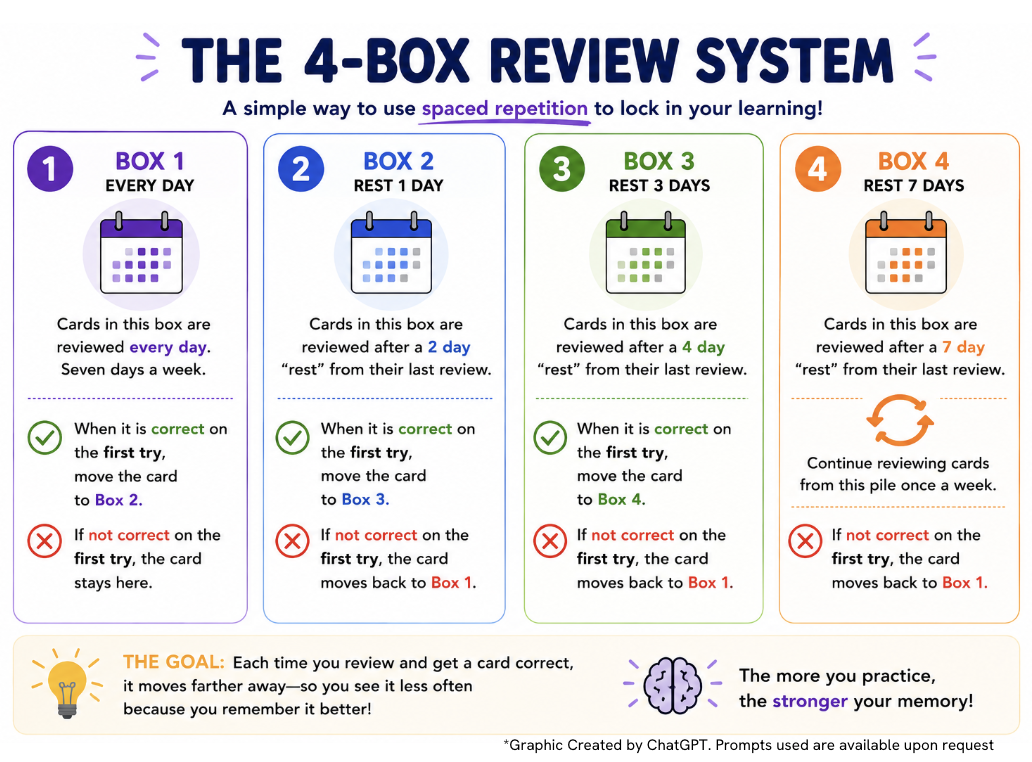
Box 1: Every Day New cards start here, and so does anything you get wrong. You review this box daily, seven days a week. If you get a card right on the first try, it moves up to Box 2. If you get it wrong, it stays put.
Box 2: Rest 1 Day Cards here are reviewed after a 2-day rest from their last review. Get it right on the first try, and it moves up to Box 3. Get it wrong, and it goes all the way back to Box 1.
Box 3: Rest 3 Days Reviewed after a 4-day rest from the last review. Right on the first try, and it moves up to Box 4. Wrong, and it's back to Box 1.
Box 4: Rest 7 Days By the time a card reaches here, you've proven you know it well. Review this box about once a week to keep it fresh. If you miss one, it goes right back to Box 1. No partial credit.
Why It Works
The goal is simple: every time you review a card and get it right, it moves farther away, so you see it less often, because you've earned it by remembering it better. Cards you're struggling with stay close, in frequent rotation, until they stick.
This matters because most students, left to their own devices, do the opposite of what actually helps. It's natural to gravitate toward the flashcards you already know, because getting things right feels good. The Leitner system forces your attention toward the cards you're actually struggling with, which is where your study time does the most good.
It also builds in real spaced repetition without you having to think about timing or schedules yourself. The system tells you exactly what to review and when. And there's a motivational side effect: watching cards move up through the boxes gives you a visible, tangible sense of progress that just re-reading a stack of notes never quite provides.
How to Actually Use This
Grab a set of index cards and a box (or a few envelopes, or dividers in a folder, or even a few binder clips. Anything that either has or can divide into four sections works). Every new card starts in Box 1. From there, the system runs itself: right answers move up, wrong answers go back to the start. All you have to do is show up and review the box that's due that day.
The more you practice this way, the stronger your memory gets, not because you spent more hours with the material, but because you spent your time where it actually mattered.
