
The Self-Regulation Loop: Plan, Monitor, Evaluate
Author: Kimberly Tierney, Director of Academic Coaching
This content was largely informed by the book Study Like a Champ. We use this book to structure our Study Smarter Not Harder summer book study.
This content was created with the assistance of AI. All content was reviewed and edited by Tierney Education for accuracy, clarity, and usefulness.
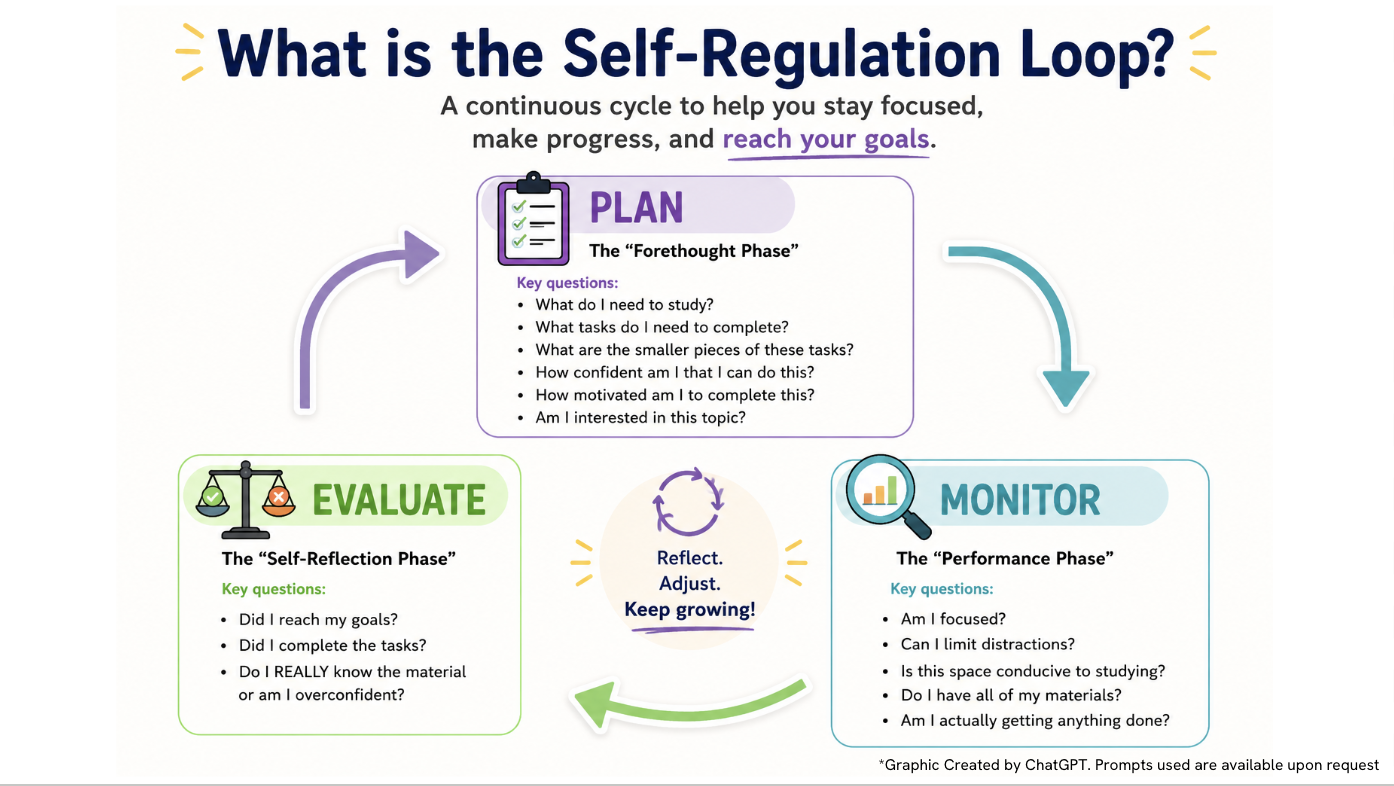
Studying isn't one moment, it's a loop. Psychologist Barry Zimmerman's model of self-regulated learning breaks that loop into three phases: forethought, performance, and self-reflection. In plain terms: plan, monitor, evaluate. The students who consistently do well aren't necessarily the ones who study the most hours. They're the ones who keep cycling through this loop, over and over, adjusting as they go.
Plan (The Forethought Phase)
Before you start, ask yourself:
What do I need to study?
What tasks do I need to complete?
What are the smaller pieces of these tasks?
How confident am I that I can do this?
How motivated am I to complete this?
Am I interested in this topic?
This phase is easy to skip. It's tempting to just open your notes and start, but a few minutes of planning changes how effective the rest of your session is, because you're not figuring out what to do while also trying to do it.
Monitor (The Performance Phase)
This is where the real work happens, and it's also where most students stop paying attention to themselves. Ask yourself, while you're actually studying:
Am I focused?
Can I limit distractions?
Is this space conducive to studying?
Do I have all of my materials?
Am I actually getting anything done?
Self-observation is the key skill here. What is the experience of studying like, right now? How am I doing? Do I need a break? The goal isn't to power through no matter what. It's to train yourself to notice what's happening and adapt in real time, instead of realizing an hour later that you've been staring at the same page.
Evaluate (The Self-Reflection Phase)
After you're done, close the loop:
Did I reach my goal?
Did I complete the tasks?
Do I REALLY know the material, or am I overconfident?
That last question is the one that trips students up the most, and it deserves its own explanation…
Calibration: Do You Actually Know What You Think You Know?
Calibration is the match between what you think you know and what you actually know. When those two things line up, you're well-calibrated. When they don't, and you feel more confident than your actual performance warrants, that's a calibration error, and it's one of the most common reasons students walk into an exam feeling ready and walk out surprised.
This connects to something called the Dunning-Kruger effect: a cognitive bias where people with limited knowledge or competence in a specific area tend to significantly overestimate their own skill. Because they lack the expertise, they also lack the self-awareness to recognize their own gaps, which creates a false sense of confidence.
The tricky part is that overconfidence is resistant to change. You can't just decide to be better calibrated. But there are concrete things that help:
Ask questions if instruction isn't clear. Confusion you don't address becomes a gap you don't know you have.
Get frequent practice. The more you actually test yourself, the more accurate your sense of your own knowledge becomes.
Reward yourself. Positive reinforcement helps the habit of checking in on your own learning actually stick.
Get good feedback, and ask for it directly if you're not getting enough. Feedback is often the fastest way to close a calibration gap, because it tells you what your own self-assessment can't.
Why Delayed Gratification Matters Here
None of this loop works without one underlying skill: the ability to delay gratification. This has been studied for decades, going back to Walter Mischel's foundational research on self-control, and the throughline across that body of work is consistent: people who are better at delaying gratification tend to be better at planning, monitoring, and evaluating their own learning (even though later research has had difficulty replicated Mischel’s extreme results, it is still agreed that delayed gratification is an important skill to practice building!).
That connection makes sense. If you can delay gratification, you can be more consistent with your study habits instead of only studying when it feels urgent. You have better task initiation, meaning you can actually start the work instead of putting it off. And you're able to more honestly evaluate your own learning instead of taking the easy, comfortable answer that you already know the material.
A few ways to build this skill in practice:
Use timers or set time limits (the Pomodoro method is a good place to start).
Set project or task milestones: work for 20 minutes before you check your phone, or finish this chapter before you do something else.
Put your phone, or any electronic distraction, somewhere out of reach, like a drawer in another room.
Break big tasks into smaller ones.
Track your progress visually so you can actually see what you've already done.
Take breaks. Delaying gratification doesn't mean never having any.
Reward yourself when you follow through.
A few more phone-specific strategies worth trying:
Move the apps you check mindlessly into folders so there's a small barrier before you open them
Use a screen time tracker app
Try an app like One Sec that adds a pause before you can open certain apps
Switch your phone to black and white under Accessibility settings. Without the vivid colors, your brain finds your phone a lot less interesting, and a lot easier to put down.
The Loop Keeps Going
Plan, monitor, evaluate, then plan again. Reflect, adjust, keep growing. The point isn't to get it perfect on the first pass. It's to keep cycling through, getting a little more accurate and a little more consistent each time!
