
Notes That Help You Remember: The 3R Method
Author: Kimberly Tierney, Director of Academic Coaching
Read time: 5 minutes
This content was largely informed by the book Study Like a Champ. We use this book to structure our Study Smarter Not Harder summer book study.
This content was aided by an AI language model. Learn more athttps://claude.com/. The graphics were created by ChatGPT. Prompts we use are always available upon request.
Most students think of notes as a record: a way to write down what the professor said so you have it later. That's only half the story. Good notes actually do two jobs, and understanding both of them changes how you should be taking notes in the first place.
What Your Notes Are Actually Doing
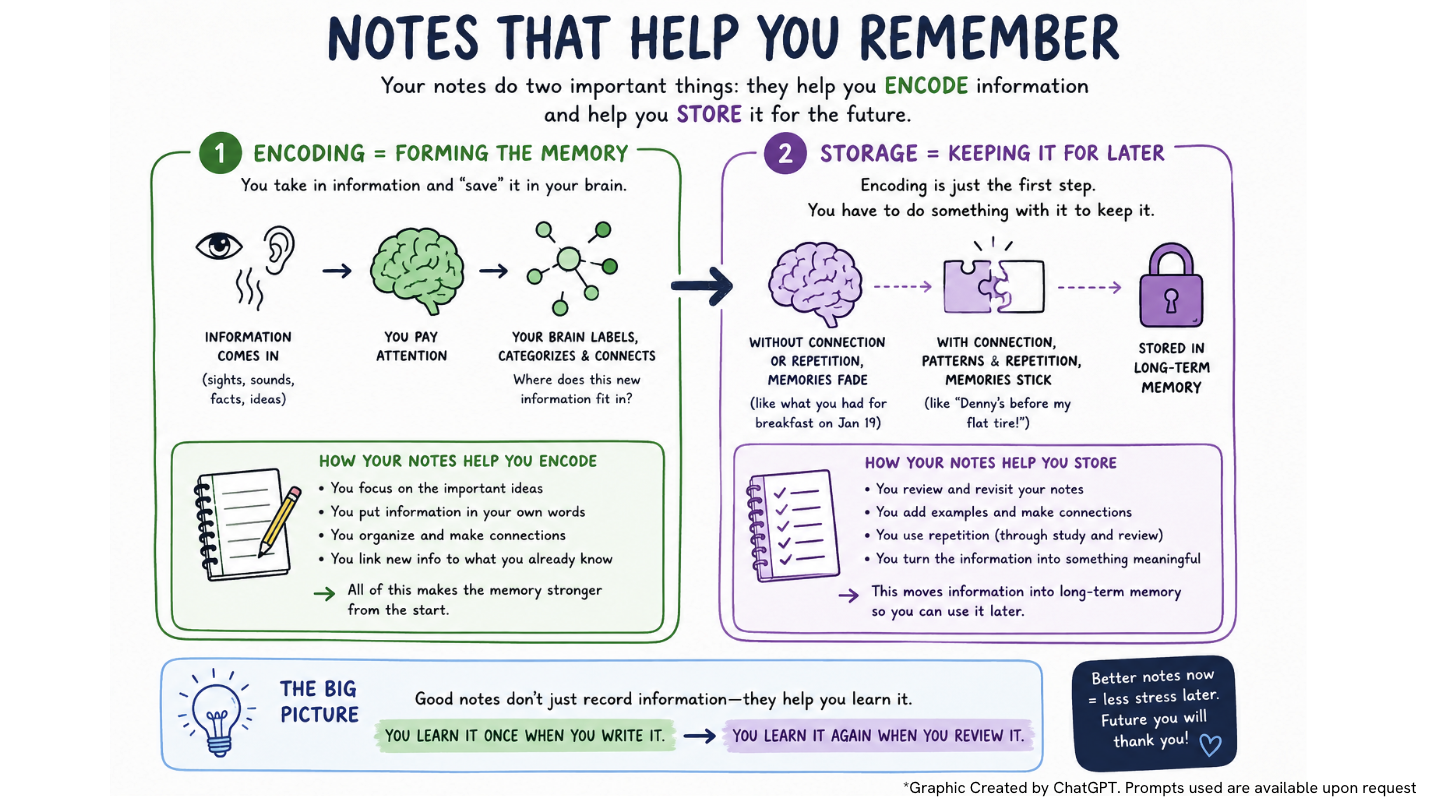
The first job is encoding, which is psychology-speak for forming a memory in the first place. Your brain is constantly taking in sensory information: sights, sounds, facts, ideas, and it can't possibly remember all of it. Imagine if you actually retained every single thing your senses picked up in a day. It would be overwhelming. Instead, your brain only labels, categorizes, and connects the things you pay attention to. It's asking: where does this new piece of information fit into everything I already know?
That's an important detail, because it means memory isn't like a filing cabinet where facts sit in isolated folders. It's more like a web, where new information sticks best when it's connected to something already there.
The second job is storage, getting that information into long-term memory so you can actually use it later. Encoding is just the first step. If you don't do something with that information, it fades. You probably encoded what you had for breakfast on a random Tuesday a year ago, but unless it connected to something meaningful, you can't recall it now. Brains like patterns, connections, and repetition. But give that same memory some context, "remember when we went to Denny's the morning before I got that flat tire?", and suddenly it comes flooding back, because now your brain has something to retrieve it from.
This is why good notes aren't just a transcript of what your professor said. They're an active part of learning. Taking them well strengthens the initial memory. Reviewing them later gives your future self a resource actually worth studying from. Good notes make the learning happen twice: once when you write them, and again when you review them.
The Handwritten vs. Laptop Myth
You've probably heard that handwritten notes are better than typed ones. That's not necessarily true. The real variable is focus, not the tool. If you've got seventeen tabs open during lecture and you're bouncing between notes, news updates, social media, and group chats, you're not actually taking notes, you're multitasking. And here's the uncomfortable truth: your brain is genuinely bad at multitasking, even though it feels like you're managing fine.
Good note-taking should force you to pay selective attention, organize ideas as they come in, and relate new information to what you already know. That happens at the note-taking stage. The deeper connections and polish come later, during review. Which means the single biggest lever you have during class isn't which method you use, it's staying focused enough to capture complete, accurate notes in the first place.
A few practical ways to protect that focus: put your phone on Do Not Disturb, turn off your Wi-Fi if you don't need it, and sit near the front, where you'd feel too obvious being off-task. And do the assigned reading before class. It gives your brain a head start on the "web" it's building, so new information during lecture has something to attach to immediately.
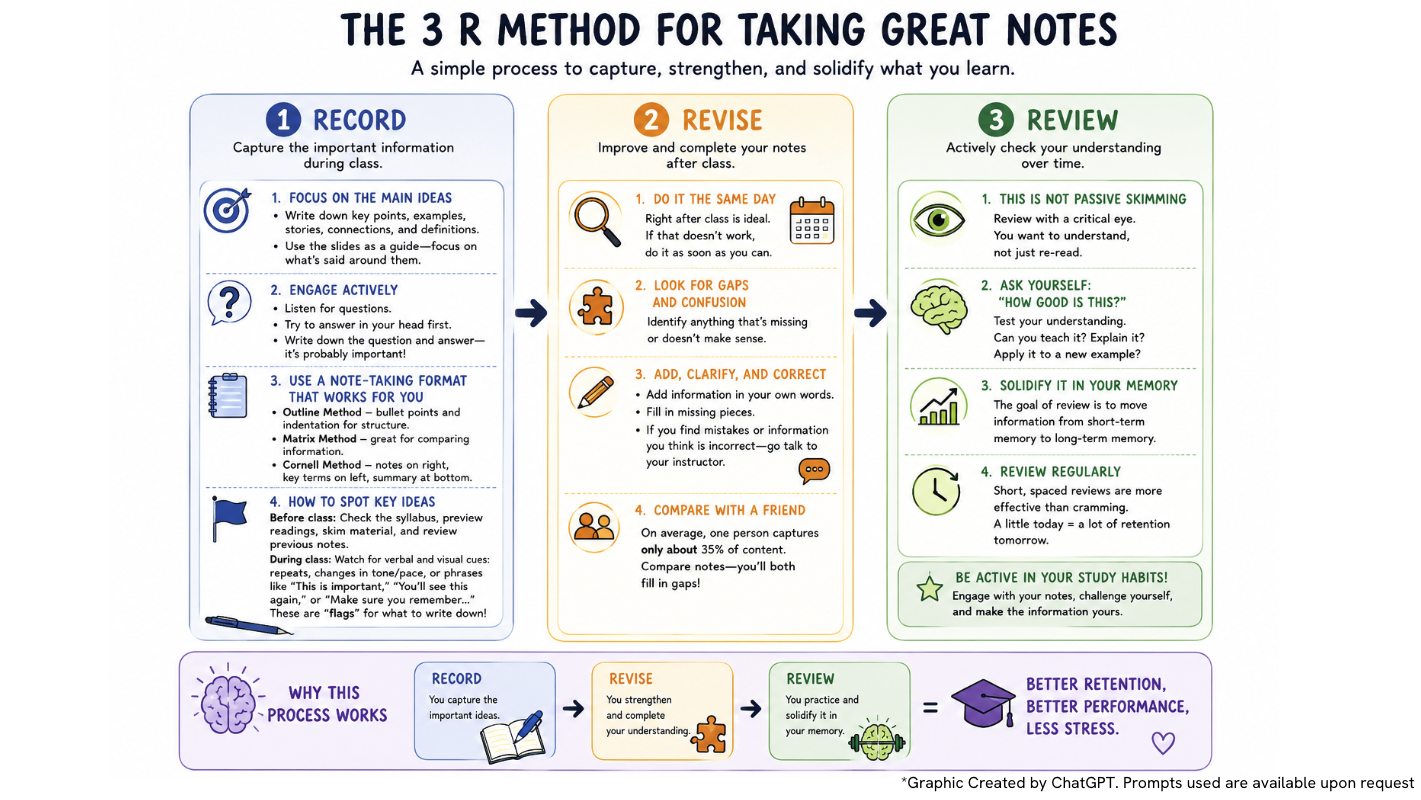
The 3R Method
With that foundation in mind, here's a simple three-step process for taking notes that actually work for you later.
1. Record
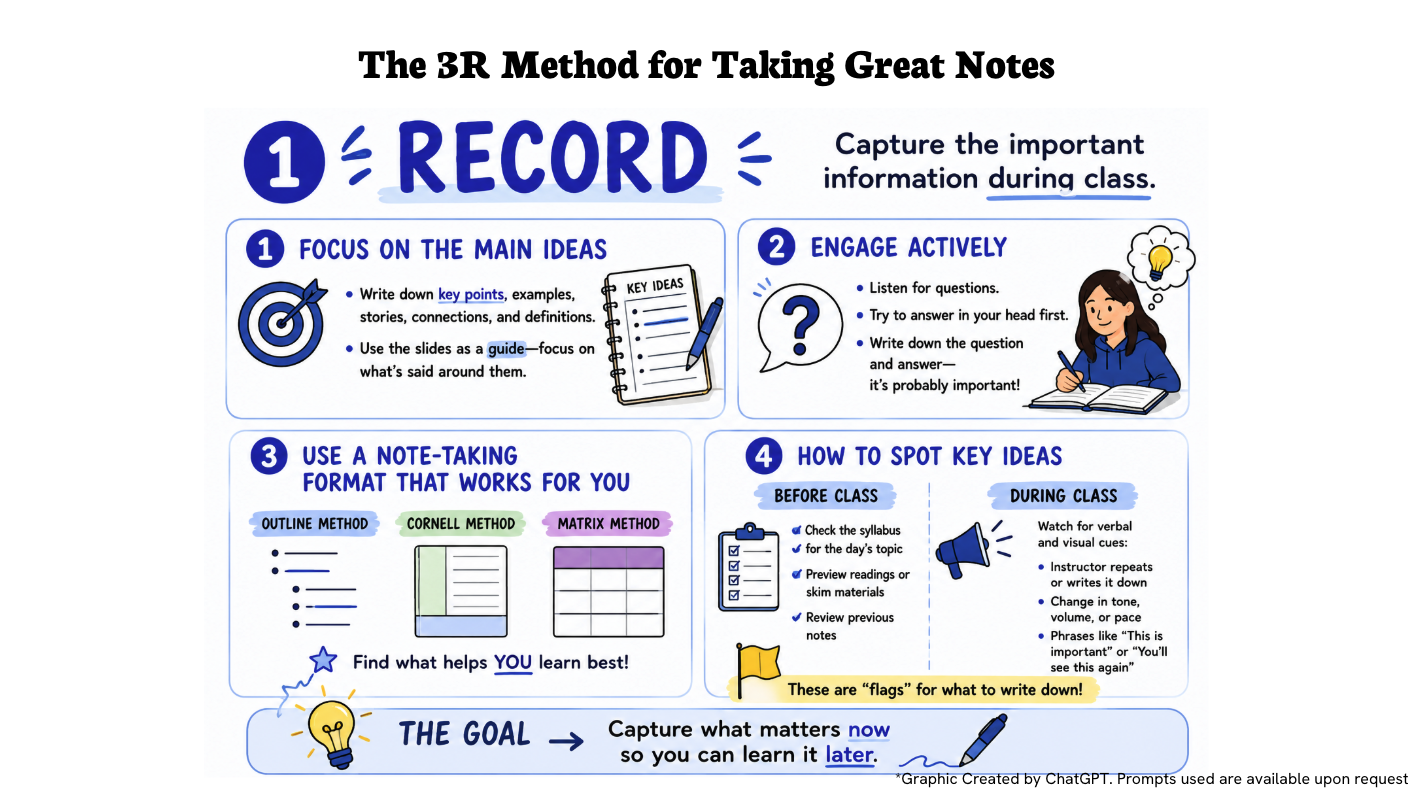
The goal during class isn't perfect notes, it's capturing what matters while your instructor is teaching. Don't try to copy every word off the slides. Instead, write down key concepts, definitions, examples, and any stories or connections your instructor makes that aren't already on the slides. Think of the slides as the outline, and your notes as what brings that outline to life.
Questions from classmates are gold. Try answering them in your head before the instructor does, and if you don't know the answer, write down both the question and the explanation. If one student was confused, others probably were too.
There's no single "correct" note-taking format. Outline, Cornell, and Matrix methods all work. The best one is whichever you'll actually use consistently. And learn to spot the instructor's cues: repeated ideas, changes in tone or pace, anything written on the board, or phrases like "this will be on the exam" or "make sure you know this." They're telling you what matters, out loud.
2. Revise
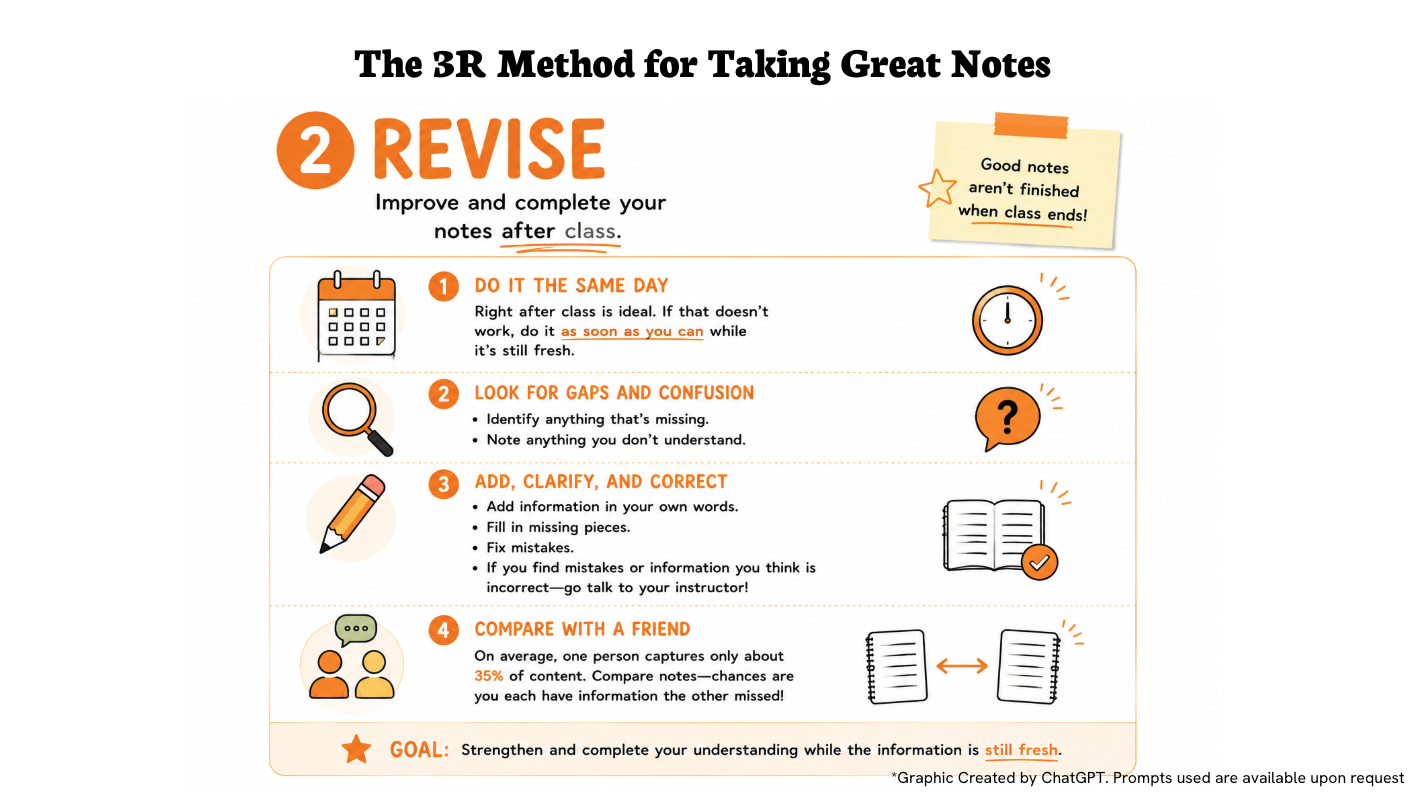
Good notes aren't finished when class ends. Ideally, revise them the same day, while the lecture is still fresh. Fill in missing information, rewrite confusing parts in your own words, fix mistakes, and add connections or examples. If something still doesn't make sense after revising, that's your cue to visit office hours.
One of the most underrated strategies here: compare notes with a classmate. Research suggests any one student only captures a fraction of what happens in a lecture. Chances are, you'll each have something the other missed.
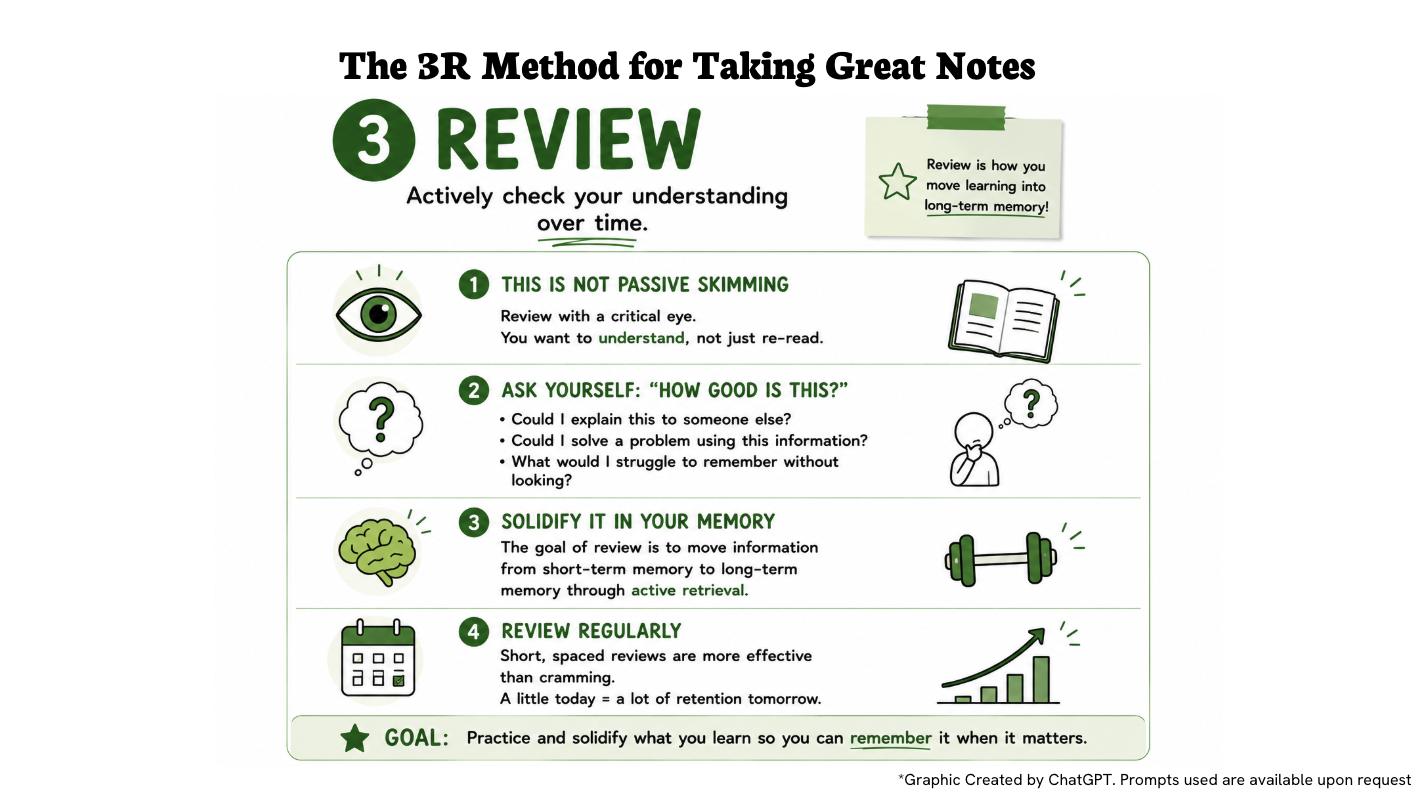
3. Review
This isn't rereading your notes and letting your eyes glaze over the page. The goal isn't to look at your notes, it's to test how well you actually understand them. Ask yourself: could I explain this to someone else? Could I solve a problem using this information? What would I struggle to remember without looking? Every time you retrieve information from memory instead of just re-reading it, you strengthen that memory and make it easier to recall later.
Why This Works
Record helps you capture and encode new information. Revise strengthens and organizes those memories while they're still fresh. Review moves that information into long-term memory through active retrieval. Instead of cramming the night before an exam, you're learning a little bit every time you interact with your notes, which means less stress, better retention, and far more efficient studying.
If you want to go deeper on the psychology behind study strategies like this one, we recommend Study Like a Champ as a resource for students looking to build smarter academic habits.
